Transient Feedback
use FirstlightUI\Facades\Feedback;

$feedbackId = Feedback::success('Appointment saved')
    ->action('Undo', 'undo-save')
    ->send();
This publishes one app-level native message and returns its stable string ID. There is no Blade tag and no host installation step: installing Firstlight registers the package-owned feedback host automatically.
Transient Feedback is for brief outcomes that may cross screen navigation. Use Callout for persistent content in the authored layout, Alert Dialog when the user must acknowledge one message, and Confirmation Dialog when work must pause for a confirm/cancel decision.
Factories and builder
The public identity is FirstlightUI\Facades\Feedback.
| API | Return | Contract |
|---|---|---|
Feedback::message(string $message) |
PendingFeedback |
Creates default-tone feedback. |
Feedback::success(string $message) |
PendingFeedback |
Creates success feedback. |
Feedback::warning(string $message) |
PendingFeedback |
Creates warning feedback. |
Feedback::danger(string $message) |
PendingFeedback |
Creates danger feedback. |
->id(string $id) |
new PendingFeedback |
Uses an application-owned stable ID. |
->action(string $label, string $key) |
new PendingFeedback |
Adds one visible labelled action and its application key. |
->hold() |
new PendingFeedback |
Keeps the item until action, manual dismissal, or programmatic removal. |
->send() |
string |
Publishes the item and returns its authored or generated ID. |
Feedback::dismiss(string $id) |
bool |
Removes a pending or visible item; returns whether it existed. |
The builder is immutable. Calling a modifier returns a new builder and does not change the instance it was called on. When id() is omitted, send() generates a UUID string.
Tones
The four factories are the complete tone API:
message()usesdefaultfor neutral application information.success()communicates a completed outcome.warning()communicates a recoverable risk or interruption.danger()communicates a failed or destructive outcome.
Tone controls native colour and a decorative semantic symbol. It does not change queue, timing, or event behaviour.
Application events
Register normal Laravel listeners in a service provider when the application needs to react to user outcomes:
use FirstlightUI\Events\FeedbackActionPressed;
use FirstlightUI\Events\FeedbackDismissed;
use Illuminate\Support\Facades\Event;

public function boot(): void
{
    Event::listen(function (FeedbackActionPressed $event): void {
        // $event->id and $event->actionKey
    });

    Event::listen(function (FeedbackDismissed $event): void {
        // $event->id and $event->reason
    });
}
FeedbackActionPressed has public readonly string $id and string $actionKey properties. FeedbackDismissed has public readonly string $id and FeedbackDismissReason $reason. The dismissal reasons are Timeout, Manual, and Action, with wire values timeout, manual, and action.
Pressing an action removes the item, dispatches FeedbackActionPressed, then dispatches FeedbackDismissed with FeedbackDismissReason::Action. The dismissal event is still dispatched if an action listener throws, and the listener exception is not swallowed. An automatic timeout dispatches only FeedbackDismissed with FeedbackDismissReason::Timeout. A manual native dismissal dispatches only FeedbackDismissed with FeedbackDismissReason::Manual.
Feedback::dismiss($id) is programmatic reconciliation. It dispatches neither event, including when it removes the visible item.
Queue and stable-ID updates
Feedback is displayed one item at a time in first-in, first-out order. Sending a new ID appends it. Sending an existing ID replaces that semantic record in place, so it keeps its current queue position:
Feedback::message('Connecting')->id('connection')->send();
Feedback::warning('Connection interrupted')->id('connection')->hold()->send();
An update can change message, tone, action, and held state. Updating the visible ID does not restart elapsed automatic time; the native host recalculates the allowed duration from the current content and accessibility policy. Completed IDs are protected from stale native frames and cannot dismiss or act on the next item.
Use a stable authored ID when later code must update or remove an item. Use the generated ID returned by send() for one-off feedback.
Lifetime and dismissal
Automatic feedback starts with a four-second minimum. Longer text may increase message time up to ten seconds, and an action adds two seconds. Platform accessibility policy may extend that duration. Automatic feedback has no visible dismiss control.
hold() disables automatic timeout. A held item presents an explicit native dismiss control with the accessible label Dismiss feedback; its optional application action remains available. Either user action advances the queue. Feedback::dismiss() removes held and automatic items alike without an application event.
There is no public duration, position, animation, swipe, close-label, or stacking option.
Navigation, background, and process lifecycle
The feedback store and native host belong to the installed package, not the screen that called the facade. Pending and visible items therefore survive normal NativePHP screen navigation. Each publication refreshes package-owned native callback IDs, so an outcome routes to the feedback service rather than to a screen that has been replaced.
Automatic time counts only while the app is active and its feedback controls do not hold accessibility focus. Moving the app to the background pauses the remaining duration; returning to the foreground resumes it. Held items do not accrue timeout time.
The store is process-local memory. Process termination clears the queue; Transient Feedback is not durable storage and does not restore messages after relaunch.
Accessibility
Each newly visible semantic ID is announced once. Updating the same ID changes the visible content without repeating the announcement. Tone symbols are hidden from VoiceOver and TalkBack, while message text and labelled actions retain native semantics.
Actions meet the platform baseline of at least 44 points on iOS and 48 dp on Android. Long text wraps, controls reflow under constrained width or large text, and both platforms preserve dark mode, contrast, and right-to-left layout. Automatic timing pauses while an action owns accessibility focus.
iOS doubles the automatic duration while VoiceOver or Switch Control is active and uses an opacity-only transition with Reduce Motion. Android passes the content type and base duration to AccessibilityManager.getRecommendedTimeoutMillis, available at the package's API 29 floor, and retains Material snackbar accessibility semantics.
Validation and failure behaviour
Messages passed to a factory and values passed to id() or action() must be non-empty after trimming. Invalid values throw InvalidArgumentException before publication; surrounding non-blank whitespace is preserved. The action label and key are always authored together through action(). Feedback::dismiss() returns false for an unknown ID, including a blank ID, rather than publishing an event.
Defensive native decoding treats incomplete native action metadata as no action; an otherwise eligible item remains visible without an action. Blank or invalid identity, message, or tone, duplicate IDs in one frame, and a missing required lifetime callback make an item ineligible. Repeated or stale callbacks produce no duplicate events.
Disabled, loading, model binding, rich content, multiple actions, icons, per-platform copy, arbitrary colours, and renderer-specific styling do not apply. There is no consumer-authored feedback-center host and no supported direct construction of the internal wire elements.
Platform behaviour
iOS presents a bottom SwiftUI material notice with semantic SF Symbols, native buttons, safe-area spacing, Dynamic Type, and a reduced-motion-aware transition. Android presents a bottom Material 3 Snackbar with semantic tone treatment, navigation-bar and IME padding, responsive action layout, and TalkBack live-region behaviour.
Both platforms own one visible item and the same FIFO/event contract. Native expression differs by platform; Firstlight guarantees behavioural parity rather than identical geometry. Held items expose a dismiss control whose visible and accessibility labels are package chrome; see Localize chrome.
Compatibility
Transient Feedback supports the package versions and platform floors in the current compatibility reference: PHP 8.4, NativePHP Mobile 4, NativePHP Mobile UI 0.3, iOS 18 or later, and Android API 29 or later. Both Firstlight native hosts must be compiled into the application.
Screenshots
The screenshot manifest reserves /captures/transient-feedback and the four paths below. bin/check-transient-feedback --development reports missing showcase, image, and review evidence without blocking documentation work. Release mode requires clean package and showcase Git worktrees, the exact Task 6 route/component/view/test fixture, structural assertions for the capture screen and deterministic feedback record, and a passing manifest-focused test. That test runs with a short timeout and continuously drained 4,000-byte diagnostic ceiling. The gate incrementally decodes each differentiated PNG, including bounded files and chunks, CRCs, streamed IDAT zlib data, exact non-interlaced or Adam7 phone-sized scanlines, and IEND at end of file.
The current spec/reviews/transient-feedback-alpha.md must name a real reviewed package commit that is an ancestor of package HEAD; only the four screenshot files and that review may change afterward. Its showcase revision must equal the clean showcase HEAD. The review records date, reviewer, both release targets, all four exact image paths, and substantive PASS or APPROVED details for capture, platform runtime, lifecycle, VoiceOver, TalkBack, physical-device checks, and visual approval. Placeholder words embedded anywhere in those identity or evidence fields block release.
| Platform | Light | Dark |
|---|---|---|
| iOS | 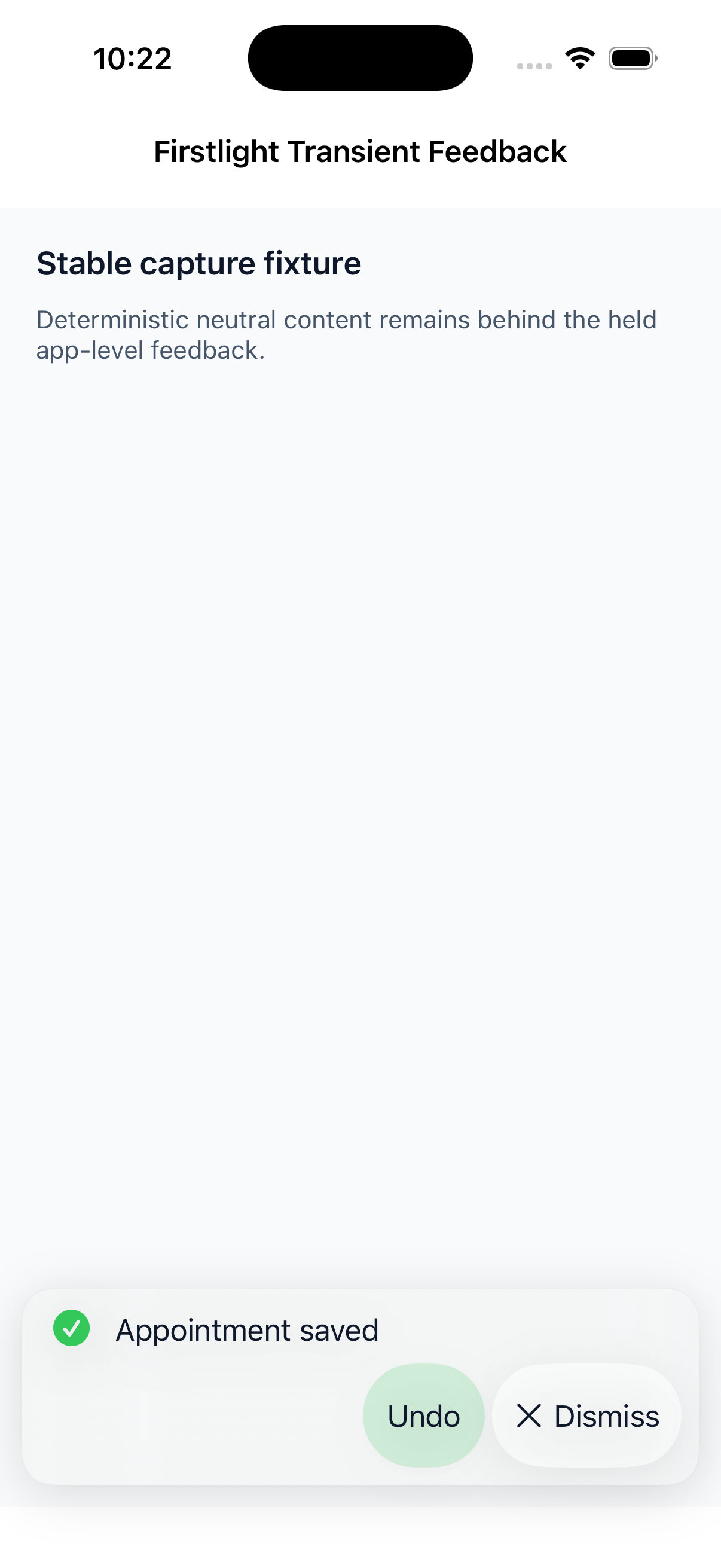 |
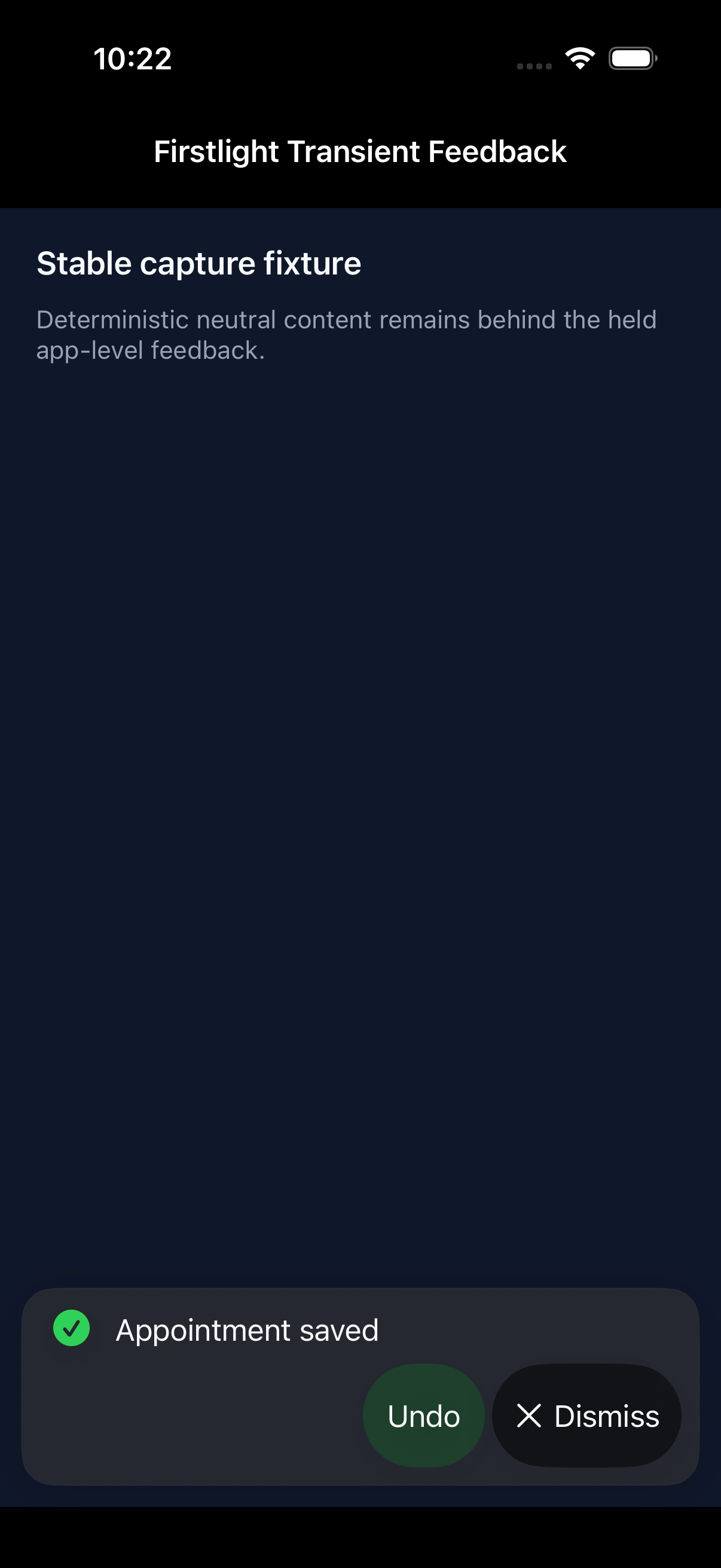 |
| Android | 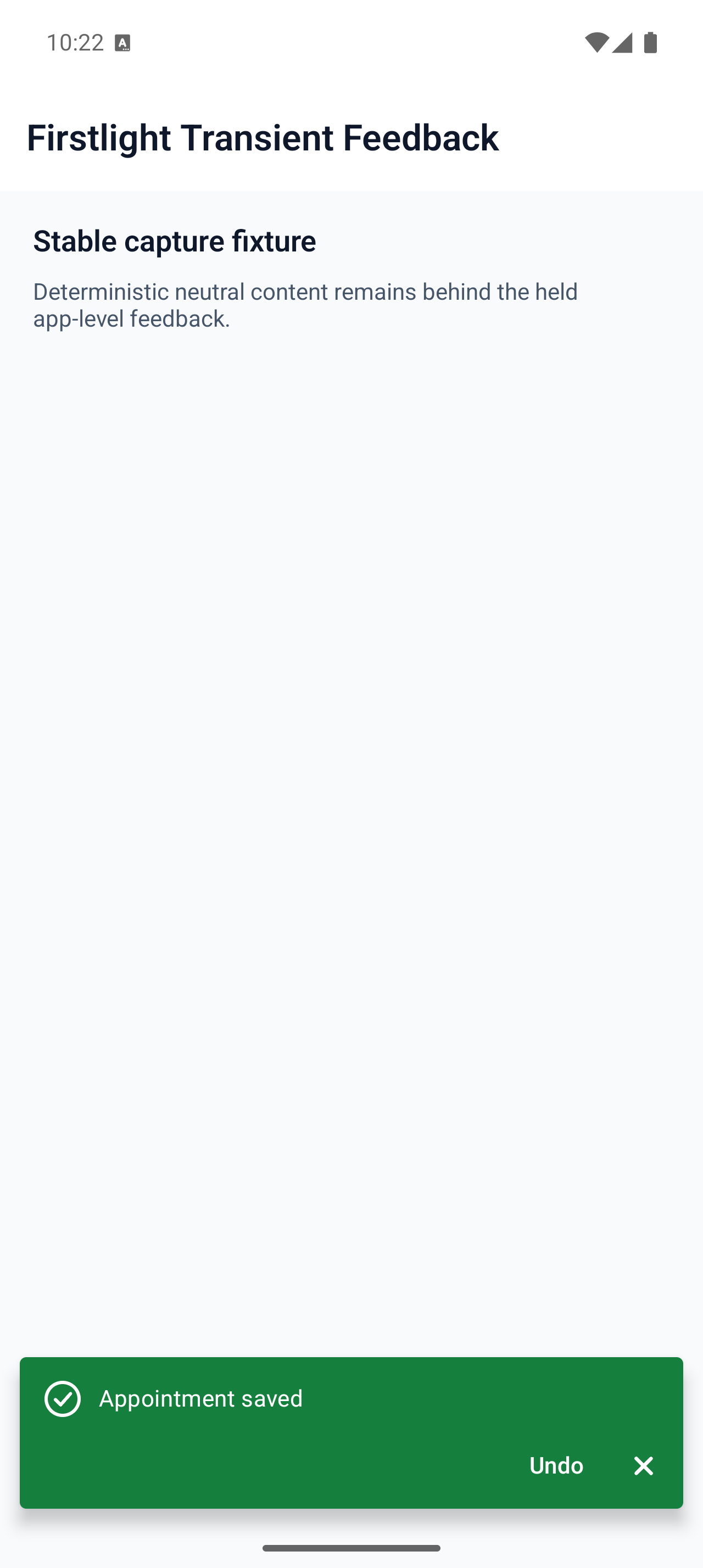 |
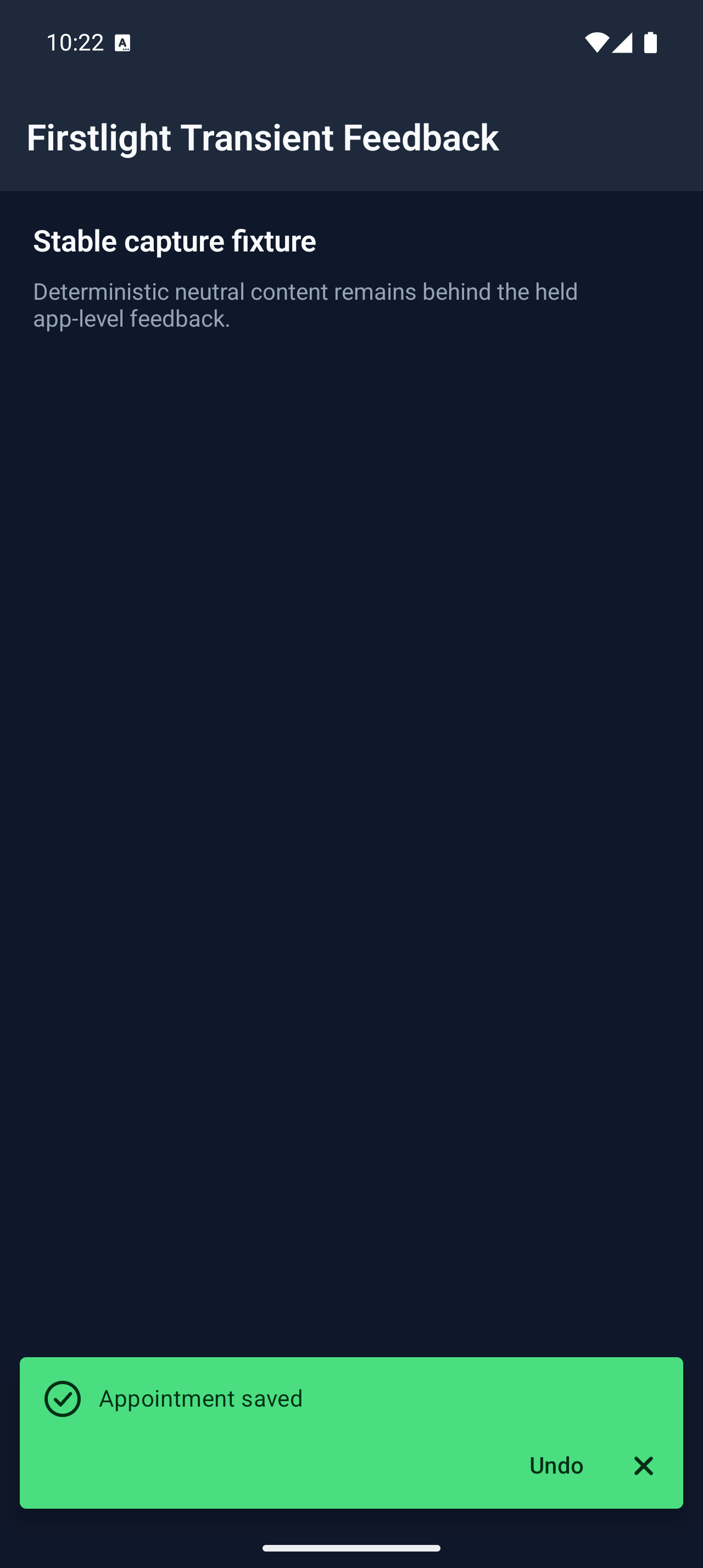 |