Stepper
Stepper moves a numeric model by one bounded step at a time. PHP remains the accepted source of truth: a tap proposes the adjacent value and the native control continues showing the accepted value until PHP publishes again.
<firstlight:stepper
    native:model="quantity"
    :min="0"
    :max="10"
    :step="1"
    label="Quantity"
    helper="Adjust one item at a time"
/>
Use Blade's : binding for numbers. Literal HTML attributes such as min="0"
are strings and are rejected deliberately.
Props
| API | Accepted type | Purpose |
|---|---|---|
value / native:model |
finite `int | float` |
min |
finite `int | float` |
max |
finite `int | float` |
step |
finite positive `int | float` |
label |
string |
Visible field label and accessible-name fallback. |
helper |
string |
Supporting guidance below the control. |
error |
string |
Validation feedback that replaces helper text. |
disabled |
bool |
Prevents decrement and increment proposals. |
a11y-label |
string |
Explicit accessible name when no visible label is appropriate. |
a11y-hint |
string |
Additional VoiceOver and TalkBack guidance. |
class |
string |
External EDGE layout for the complete field. |
min must be less than max. The accepted value must be within the inclusive
bounds, and both it and max must lie on the step grid originating at min.
Numeric strings, booleans, null, non-finite values, native Float overflow,
off-grid values, and grids larger than the signed 32-bit interval limit are
rejected. Values are never clamped or coerced.
Exact PHP number types
Stepper preserves intentional PHP number kinds. If value, min, max, and
step are all integers, proposals are integers. If any one is a float, all
numeric tree props and proposals are floats, even an integral value such as
5.0. An omitted step defaults to integer 1 for an otherwise integer model.
public int $quantity = 5;
public float $dose = 5.0;
Decimal grid comparisons tolerate only normal binary floating-point noise such
as 0.1 + 0.2; the public value still has to be on the authored grid.
Events and server authority
Use @change, plain native:model, or native:model.live. A decrement or
increment sends one adjacent precomputed value through the standard callback.
Blur and debounce modes are rejected because a step is already an immediate,
discrete action.
After a proposal, another tap is ignored until the server publishes the node again. This prevents stale rapid taps from calculating against an old accepted value. The control does not change optimistically and performs no arithmetic on the device.
NativePHP Mobile 4.2.0 still needs a content-independent publication acknowledgement from the bundled PHP runtime when PHP rejects a proposal and republishes an identical accepted value. Stepper remains release-blocked on that upstream behaviour (#365); accepted changes already reconcile normally.
Accessibility and platform behavior
Contract exceptions still reject invalid numeric grids before publication.
User validation is separate: screens that use ValidatesFields auto-bind the
first MessageBag message for the field's native:model or error-for name.
An authored error wins. See Validate fields.
Provide a visible label or an explicit a11y-label. VoiceOver and TalkBack
receive the accepted value, hint, helper or error, disabled state, and named
decrease/increase actions. At a boundary, only the unavailable direction is
disabled.
iOS uses the genuine SwiftUI Stepper. Android uses Material 3 icon buttons in the idiomatic minus/value/plus arrangement. Stepper deliberately has no custom icons, formatter, min/max captions, wraparound, orientation, long-press acceleration, required state, size, variant, colour, or style escape props.
Screenshots
| Platform | Light | Dark |
|---|---|---|
| iOS | 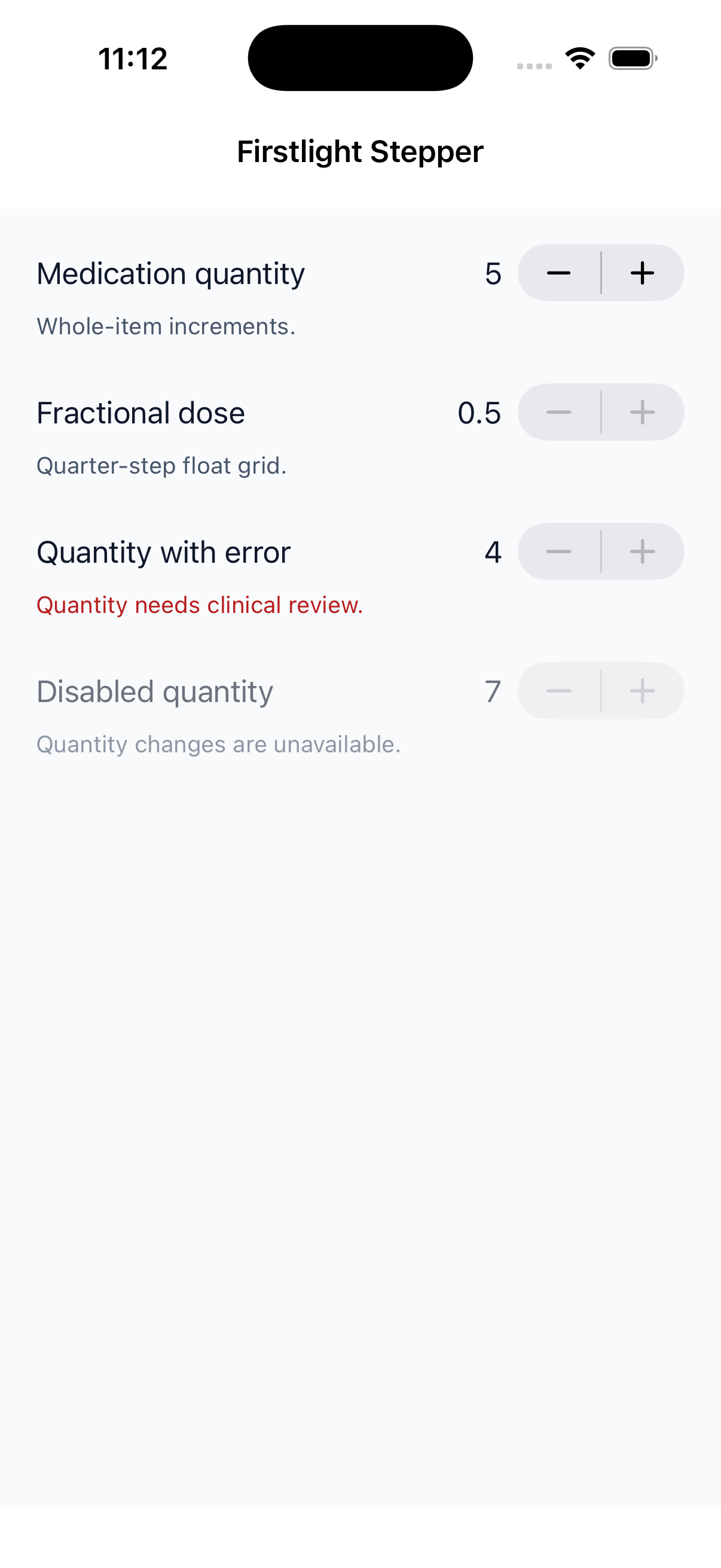 |
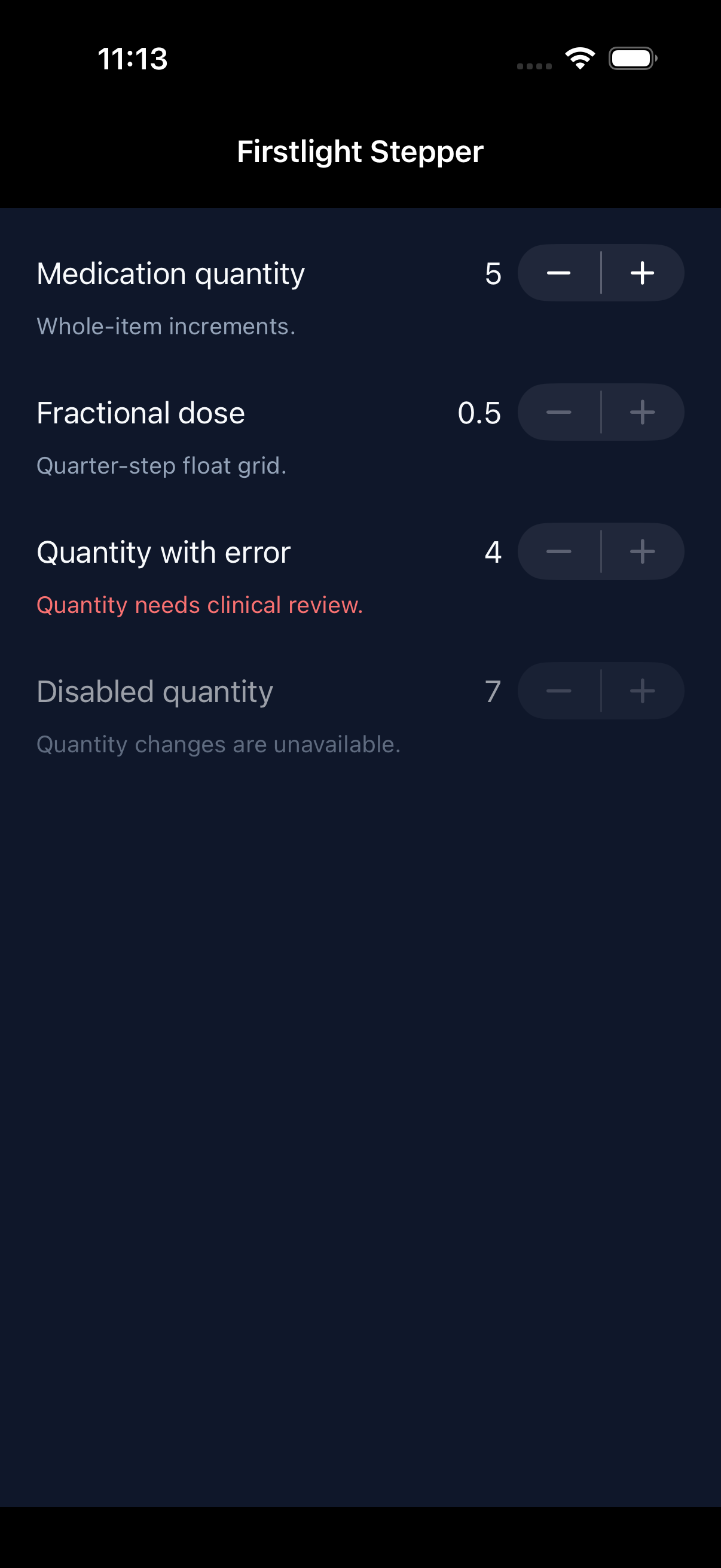 |
| Android | 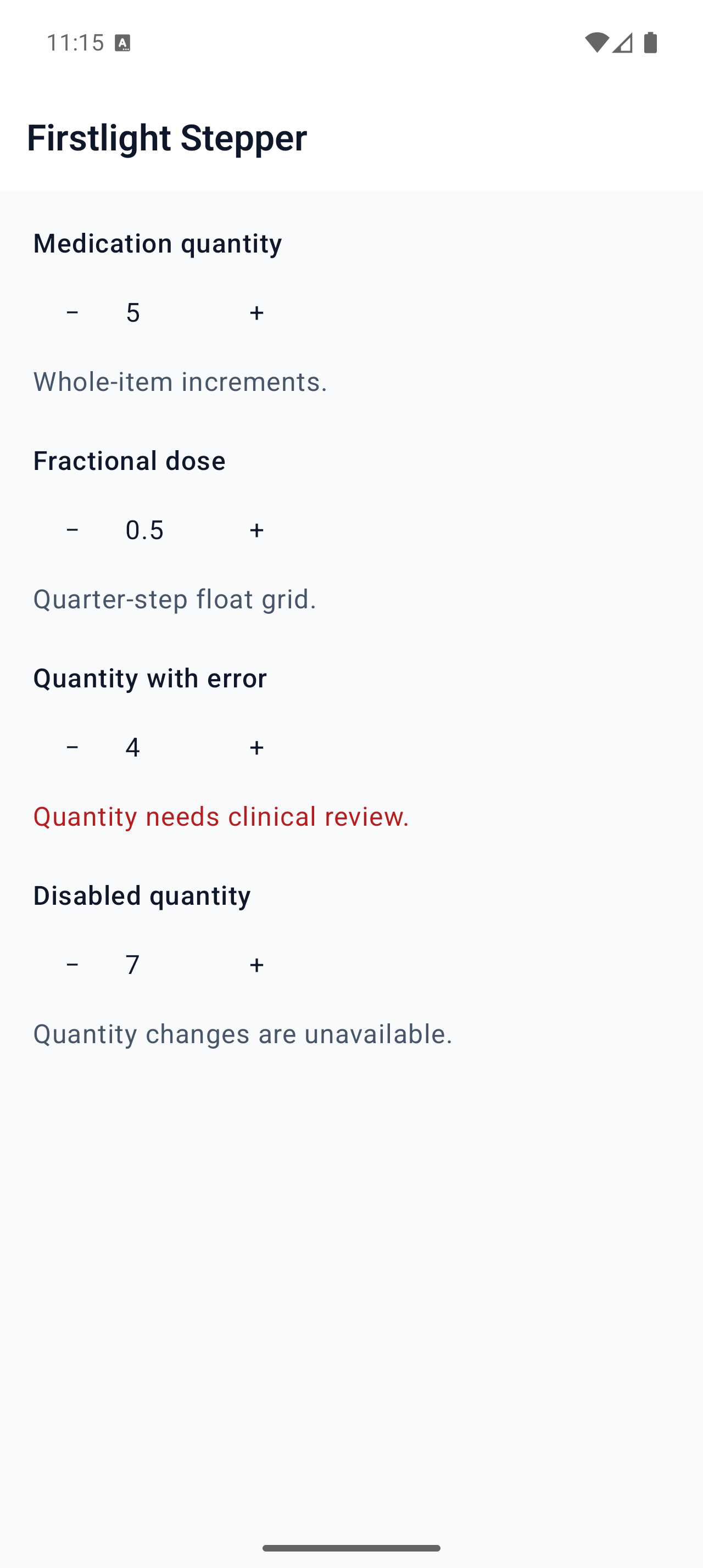 |
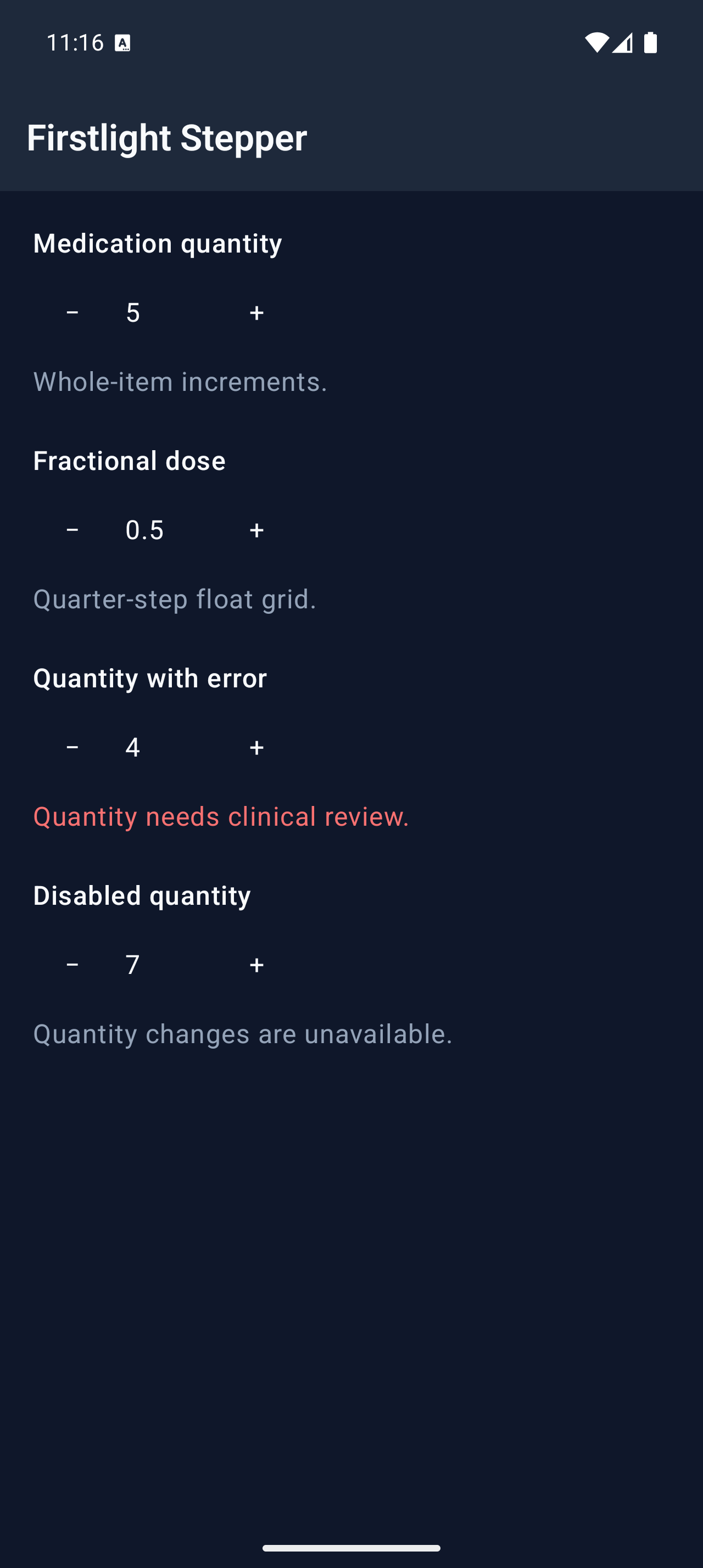 |